Showing posts with label Design. Show all posts

Wednesday, 24 May 2017

Domestic Cupola


I was asked to replace a discoloured and plain cupola in a 1930’s bungalow.


It is lit from above both by a roof light and by internal lighting in the loft space.  This meant that a design could be employed that would be visible both by day and night.

The brief was to bring something of the Arts Nouveau into the design.  The design could have been the repetition of a design element in all eight parts, but I wanted to work with the whole as one piece.  After some discussion on the themes it was settled on a flower and leaves theme.

My first design was developed using a template of one of the triangles forming the cupola.


However, in my enthusiasm for the sinuous curves for the stems and buds, I forgot the need to include the roses that were discussed and agreed upon.
[Anderson 2nd design web]


This one does include the roses.  And I do know that the roses in nature would be open after the other buds, but some artistic license was accepted. And the building of the panels began.

Installation required the removal of the old glass.  As the house had just been completely redecorated, lots of old carpet and dust sheets over them was required to protect against any glass falling and possibly puncturing the new wood flooring.


Already the simple removal of the nicotine stained amber glass transformed the light within the hallway.

The installation began by installing each numbered piece in order, as any misplaced panel would interrupt the flow of the design.  However, it would have been better if templates for each of the eight openings were taken.  The openings were not completely regular. 


When complete, it provided a new interest to the hallway as well as allowing much more light into the space. The straight lines running through the composition are the location of the support bars for the glass.


Best of all, the client was overjoyed at the result, bringing relatives around to see what had been achieved.

Friday, 14 August 2015

Cupola


A client has recently purchased a house built in the early 1920’s.  It contains a cupola that has become ugly over the years through exposure to nicotine and general dirtiness.


Rather than trying to clean it, the client has decided to replace it with something in keeping with the period of construction that will allow light through into the hallway, but also obscure the view of the roof.

After trying out several ideas, I came up with one that I liked and developed it.


In my enthusiasm for the flow of the piece, I overlooked the desire for roses that the client had expressed.  The client gently pointed this out to me when I showed the design.  Oops, time for a re-think.  Everyone agreed that the flow of the green forms, although not rose leaves was desirable.  You can see the beginnings of a re-design on the original.

So I came up with a variation.  I worked on making a simple but clearly rose shape instead of the elongated buds that were the colourful feature of the first design.  I also worked to bring more of the colour lower into the panels.


You can get a better impression with the new design over laid on the old.


This is now at the glass cutting stage and soon to move to the building of the panels.

Sunday, 17 June 2012

Etched Glass

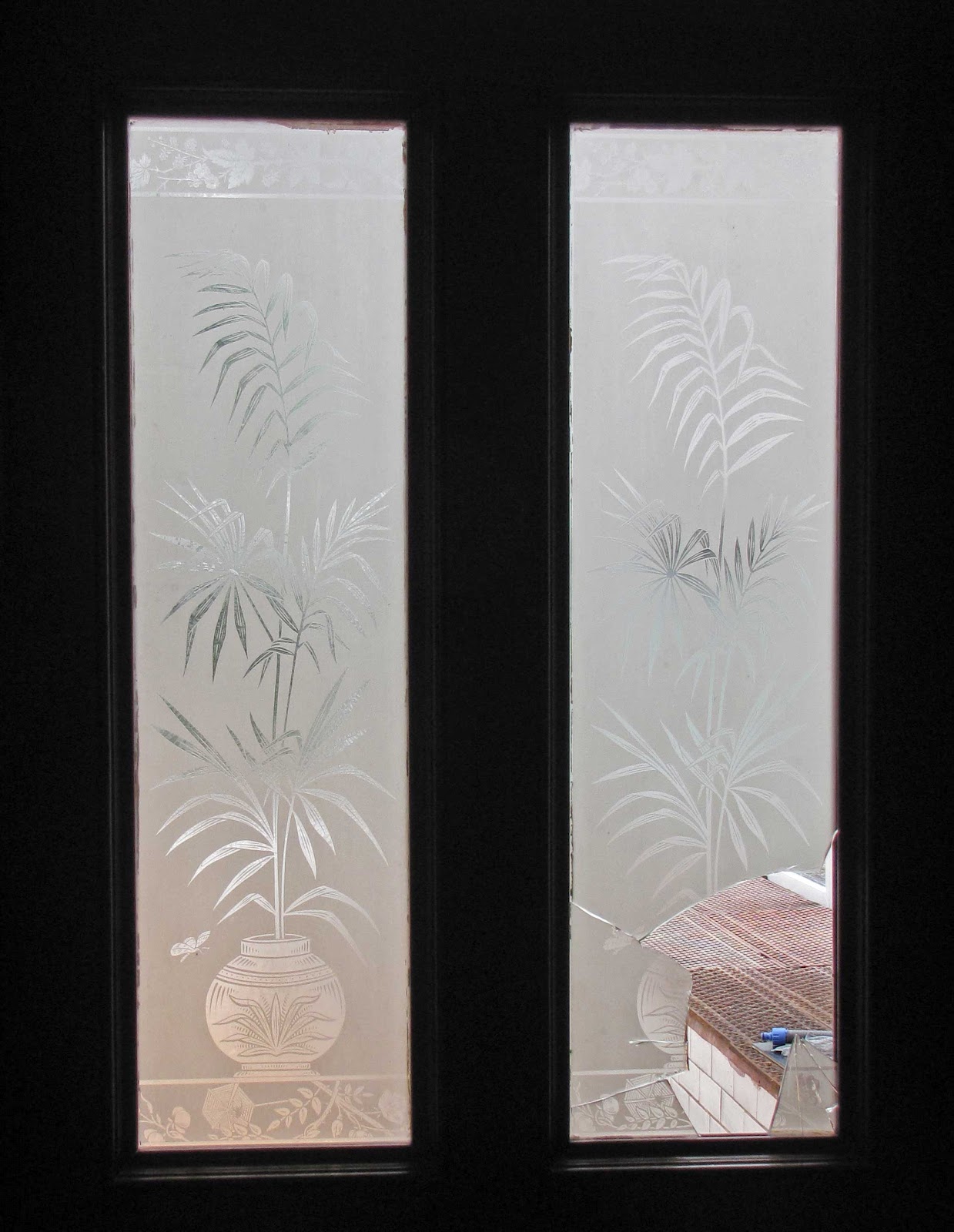
Bad things happen to glass when there are break-ins.  In this case, a plain window was broken through to get things in and out, but while there they broke a turn of the century acid etched door panel to get to an empty conservatory.  Then they took the family's van to transport the looted things away.

So, a couple of days later I get a call to come and have a look at what can be done to repair or replace the window as the insurance company is not sure how much it wants to pay for all the stolen goods and damaged glass - fortunately not much damage was done within the house.

The entry to the house has a very colourful painted, stained and leaded surround to the doorway.


I did wonder if the clear door panel was once also leaded glass.  But no this was not the damage.

The hallway is cruciform in plan, and as I turned to the right, I saw another really nice entry to and from the side garden.


I could see almost immediately that this was not the door with the breakage, but I could not resist a closer look at the door.


This is a very detailed piece of work of a very high standard and I was pleased to see that it had not been damaged.

The door I was there to look at was behind me on the left.


This was the door panel broken to see what was on the other side, as they did not even unlock the door, once the glass was broken and they could look through.  It must have taken a pretty big blow, as the glass is 8 mm thick.

In considering making a replacement, I was lucky.  Both panels are identical, not even mirror images.  So I could take a rubbing of the left panel to recreate the right panel.


Some of the work on this panel is detailed, although more stylised than its opposite number.  The top of the panel has a band of vine leaves, which sits oddly with the bamboo below.


However there may be a connection as the door leads to a very large conservatory (or as we would now call it - greenhouse - with heating pipes for the plants on the staging and underfloor heating and vents for the general run of plants.


The Scottish traders may have brought back the Japanese symbolism of strength and endurance for the bamboo.  Then of course the fondness of a glass of claret on a winter's evening may have something to do with the vines.  But that is all speculation.

More to the point is the ability of the etched panel to reflect the colours on the other side of the door.  In this case, as the camera is point downward, the colour of the terracotta floor tiles is picked up to give a pinky orange glow.


This glow disappears as you bend down and the line of sight is once again upwards.  Here on the bottom border are briar roses.  So the strength and endurance of the bamboo is surrounded by the temporary nature of the rose and dual nature of the vine and its product.  Again mere speculation.

I do enjoy the little bits of humour with the incorporation of the spiders web and the delicacy of the butterfly against the strength of the bamboo.

Now to satisfy the insurance company that this replacement panel needs to be done with the traditional French embossing method, rather than the cruder sandblasting, or even worse - they suggested a sandblasted replacement of both panels with a standard design.

Oh, yes.  After taking the rubbing, measurements, and photographs, I decided that the front door probably was also an acid etched one, rather than leaded.  It probably was lost like a lot of acid etched front doors by impact damage through the door slamming or vandalism.